Tuesday, October 22, 2013

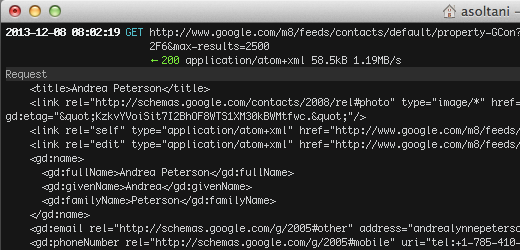
"It appears that it's an Apple issue"

Does this make any sense to you at all?

No?  Well, you are not alone.  Perhaps a comforting thought as Halloween approaches.  But this is what an eavesdropper might be able to catch your iMac/iPad/iPhone/iTouch sending, in clear text - that is without any encryption.

Now that I've got your attention, let me tell you when and how this can happen.  It occurs whenever you have your Apple Contacts list synchronized with another program, such as Facebook, GMail, HotMail, etc.  and that other program doesn't have a contact that the Apple Contacts program has.  This might not seem like you'd ever be a victim of data loss, you don't sync your contacts, right?  Well, according to +Dan Goodin 's excellent article in Ars Technica (herea whole lot of addresses have been obtained by experts such as the NSA, by being aware of vulnerabilities like this one.

I am not going to fault the NSA or any other government service for combing the net and teasing out information legally available to them.  But remember - you (and I) are not alone out here on the internets, and if the NSA can grab this information, others will try.


Friday, October 4, 2013

Comcast (that's right - COMCAST) Keeping Your PC Free

OK, it's a teaser headline, but only sort of.  Comcast's self-interests are really helpful sometimes, and I am shocked - shocked! that more people don't know this and help themselves out.

Enter: Comcast ConstantGuard

This program is offered to all Comcast Internet Subscribers (is that you?) and is a platform for Comcast to offer you services such as cloud backup, a snazzy toolbar, and the kind of identity protection formerly offered by many credit card services - in other words, stuff you either don't want or already have.  But there are still two good reasons to download the ConstantGuard:
  1. ConstantGuard Mobile - an app for managing passwords securely on your Android or iPhone.
  2. Norton Security Suite from Symantec can be installed through ConstantGuard completely free to the user, for as long as the account is active with Comcast.
The Norton Suite is especially important - you can install it on all of your computers, and you are prompted when your system needs some fixin.'  How do you fix?  You click the button marked 'fix' and that's that.

Lest you think this is not such a big deal, consider a recent attack by the ZeroAccess botnet, which Symantec discovered early on and defended against.   Over a half-million PCs targeted by this attack were defended successfully against the attack by the Security Suite updates.  The best part?  Those PC users didn't have to do anything, once the Security Suite was installed.

Got Comcast?  Get ConstantGuard.

Monday, September 23, 2013

Amazon Selling to Decrease the House Clutter

Like many people of a certain age, I have accumulated a lot of books, music, etc. in my home, and enough has become too much.  Now that grad school is over, I decided to explore the idea of selling my school books on Amazon.  I had noticed that when I was looking for some of my texts, the only way I could get them was buying them second-hand, so I knew there was some market out there.
So this morning, I stacked the texts up on my desk, and transcribed the ISBN codes into my Caliber database.  Doing this made the whole group easy to manage, since when I entered them, the lookup brought back pictures and other information about each one.  Later on, I cut/pasted each ISBN into Amazon.com's Selling program page, where it too brought up what Amazon knows of the books.  This part was really useful, since I was able to reference the page and see what others were charging for their copies of the books, respective of the condition of each.

After completing my list, I shut down my browser and went out to see a friend.  When I came back later tonight, I was notified I'd already sold one of my accounting books to someone in Washington State.  Yay, Amazon!  One down and fifteen more to go.... I could get to like this.

If any of my friends wants to learn more about this, write me a private PlusPost and I'll tell you how.

Cheers!

Tuesday, August 27, 2013

Phishing Trip #2,013: Your Browser's Fallen and It Can't Get Up

Plus mage +Stephen Allen  posted a note from the ever-vigilant anti-badness company
+Malwarebytes  (thanks Stephen, great call to post this) about a new vector of attack:

Clever pages pretending to be your favorite browser (of at least three at the moment) show up suddenly on your screen, that tell you an emergency update is needed, and you'd better do it right now.

If you try to click away from these pages, you get pop-ups telling you "later is a bad idea, do it now!" that are very, very difficult to get around.

"Oh, no, you would never fall for it.  Except..."

We're all in a hurry while we're - well, while we're doing everything.  And when a message gets in our face often times we're just like, 'yeah, OK, but hurry up fuccrissakes and git'er'done quick, all right?'

In this case, not a good idea, really, so please, take a moment right now and read the post from the nice folks at Malwarebytes, which is here.  

If you have not already done so, I absolutely recommend purchasing Malwarebytes for all of your PCs in the house.  Sure, you have Symantec or similar, but .... do this anyway, because you won't be sorry if and when you are exposed to something awful in your travels.  Sure, it's free to download after you need it, but do you really want to be looking to download something when you're trying to remove something you already downloaded?  

Hmmmm.  I thought not.

Wednesday, August 14, 2013

"...I don't care what they say, so long as they get my name right in the paper"

I've heard this comment a number of times.  Mostly attributed to attorneys or Snidely Whiplash types, and the idea behind it of course is that no publicity is bad publicity.  This is true especially on the internets, where as on Tralfamadore, everybody knew, knows, and will know, your name.  Forever.


If you are at all like me, you tend to bark about things you dislike in addition to those that you like, and this can cause a conundrum:  How do I tell you about the heinous behavior of, say, "Company X" without increasing their web page's hit rate?  This is exactly what Do Not Link is for, as described in this article by Tim Farley.